
UNBONDED POST-TENSIONING OF FACE LOADED URM CAVITY WALLS UNDER SEMI-CYCLIC AND DYNAMIC LOADING
NZSEE ANNUAL CONFERENCE (2020), PAPER 0122
Scope and methodology
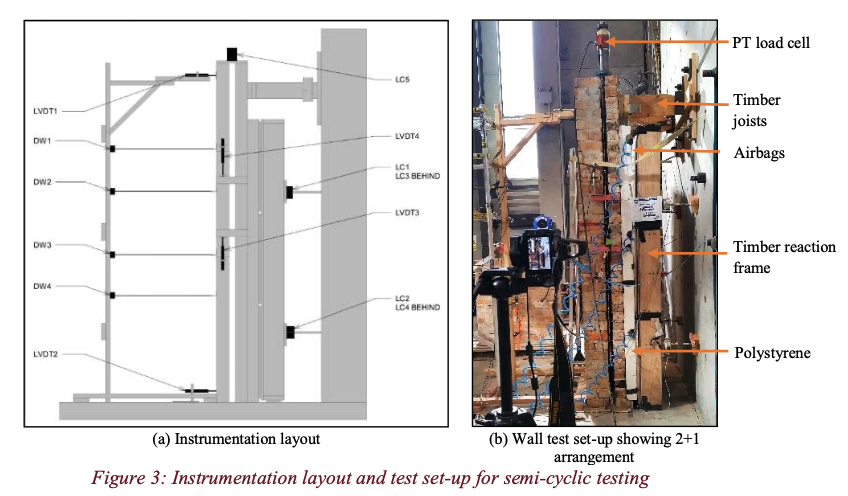
Tested five full-scale, one-way vertically spanning URM cavity walls, 9'-10" (3000 mm) high and 45" (1150 mm) wide. They were built from vintage 1930s clay bricks and a weak 1:2:9 cement:lime:sand mortar.
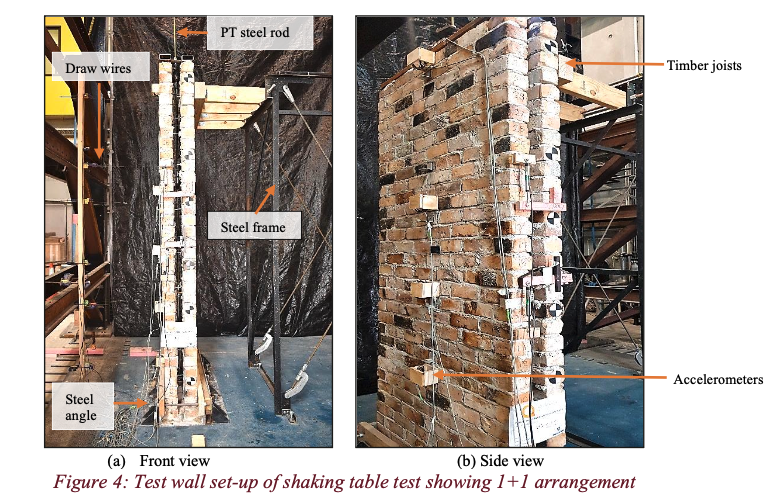
Two typologies were tested: 1+1 (two single leaves, 11" (275 mm) thick) and 2+1 (a solid double leaf plus an external single leaf, 15-1/2" (395 mm) thick). Both had a 2-1/8" (55 mm) air cavity and notched wire ties to simulate corrosion.
The retrofit was an unbonded 5/8" (16 mm) grade 8.8 threaded rod, post-tensioned to between 2.2 and 18 kip (10–80 kN). It was anchored at the base with a steel plate, through-bolted short rods or a grout plug, and at the top with an 18" × 18" × 5/16" (450 × 450 × 8 mm) plate.
1/4" (6 mm) screw cavity ties, 9-1/2" (240 mm) long, connected the leaves at approx. 18" (460 mm) horizontal × 16" (400 mm) vertical centres to prevent buckling under PT load.
The top of each wall was restrained by a timber stringer fixed with three 5/16" (8 mm) × 9-1/2" (240 mm) PYTHON MT screws, representing a timber diaphragm connection.
Three walls were tested under semi-cyclic airbag loading and two on a shake table. The shake table used 2011 Christchurch earthquake records (LPCC and CBGS), scaled from 10% to 125%.
FINDINGS
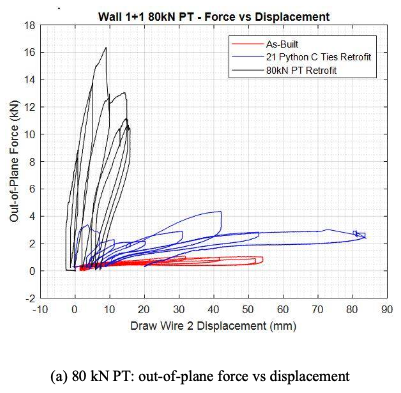
Post-tensioning increased out-of-plane capacity by about 4× compared with as-built walls of the same configuration.
The 1+1 wall reached 3.7 kip (16.4 kN), about 1.2g, against a 0.25 kip (1.1 kN) as-built capacity. The 2+1 wall peaked at 8.8 kip (39.1 kN), about 2.0g, at 4.3" (110 mm) displacement.
Wall arching raised the rod tension during loading. The force rose 130% from a 2.2 kip (10 kN) initial load, and from 18 to about 24.7 kip (80 to 110 kN). Low initial PT forces still engaged the system.
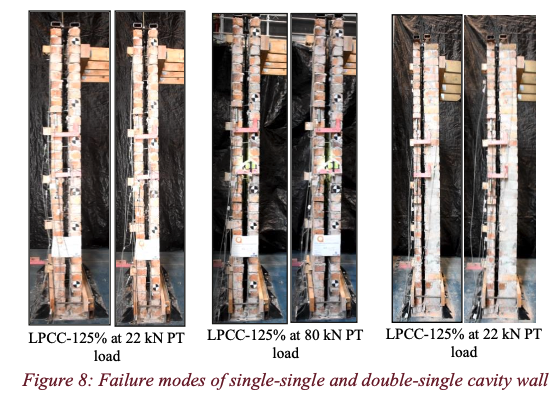
On the shake table, the 1+1 wall at 18 kip (80 kN) PT showed no noticeable damage after seven records up to LPCC-125% (PGA 1.03g). At 4.9 kip (22 kN), only minor cracking occurred at PGA 1.21g (1+1) and 1.1g (2+1), with no sign of wall instability.
Mid-height drift at 4.9 kip (22 kN) PT was 1.75% (1+1) and 1.07% (2+1). Raising PT to 18 kip (80 kN) cut the 1+1 wall displacement by about 38%.
At ultimate load, the walls cracked and slid just below the rod anchorage. This reflected the test set-up. In a building, the rod would extend below the floor diaphragm and prevent this mode.
Unbonded post-tensioning was found to be a cost-effective and constructible way to significantly improve the seismic performance of URM cavity walls.